As part of the virtual book tour for my memoir, I was invited to write a guest post for The Cuckleburr Times, an online magazine for writers. This is the post I wrote; it's called "Touching on What We All Share." This is how it starts:
I recently published a memoir, And Twice the Marrow of Her Bones, about my daughter Timora’s struggle to lead a normal life while battling leukemia, and about my own journey as a mother while she was ill and as a bereaved parent after she died at the age of eighteen. To my delight and deep gratitude, “compelling,” “moving,” and “inspiring” are just a few of the kind words readers and reviewers have used to describe their reactions; many have said they couldn’t put it down – even stayed up all night reading it. I believe this is so partly because I wrote the book straight from my heart, the way I wanted – needed – to write it, rather than thinking about marketing considerations in mind, or obeying accepted wisdom in the publishing world.
You can read the rest here.
Wednesday, May 04, 2011


Monday, May 02, 2011
Twice the Marrow Virtual Tour: Review
Today Yocheved Golani's review of my memoir was republished in her blog: It's MY Crisis and I'll Cry if I Need To. The post, which is entitled Death and Dying: Addressing the Hardest Medical Subject with Compassion, starts thus:
"B'SD 28 Nisan 5771 Today this blog is part of a Virtual Tour for the book you see above. I reviewed it months ago and came away deeply impressed."
You can read the entire post here.
"B'SD 28 Nisan 5771 Today this blog is part of a Virtual Tour for the book you see above. I reviewed it months ago and came away deeply impressed."
You can read the entire post here.
Overwhelmed - and Grateful
In this installment of my “Grief and Gratitude” series, I’d like to talk about my thankfulness for something that many may think a strange thing to be grateful for – the fact that I have too much to do.
In my former life, I too would have thought this strange. When I was raising seven children with a full-time-plus career, I always had too much to do, and I was always exhausted and often distressed. I dreamed of a time when every hour of the day wouldn’t be over-booked. A time when I’d be able to read, meet my friends, take a nap…that would be Heaven, I thought.
After Timora died, I found myself with all the time I wished for back then, in my old life – and it was Hell. As I expressed it in my original blog (and described in my memoir), “Not only did I lose [Timora] herself, but I lost a whole world of experience, as the activities on which I’d been spending a great deal of my time suddenly became irrelevant; I literally didn’t know what to do with myself.” Unable to work, unable to concentrate on anything other than what I absolutely had to do, I awakened every day to the prospect of hours upon hours of empty time stretching before me.
Now, ten years later, my life is full again – perhaps too full. I have my work, my marriage, my children and grandchildren, my writing, my improvisational theater group, my book club…I’m sure I’m forgetting something. But after going through that emptiness, I appreciate every single activity I’ve crammed into my overflowing life.
Now, whenever I start to feel overburdened, I think of all the reasons for which I could have too little to do. I, or a significant other, could be ill, or severely disabled. I could be unemployed. I could be poor, and not able to afford drama groups, books, or even train fare to visit my children and grandchildren. I could have no friends to meet. For that matter, I could be in prison…. You get the idea.
Yes, I’m tired, and sometimes feel overwhelmed. But I thank God that the opposite is not the case, and that my life is now filled to (and over) the brim with stimulating, meaningful, and satisfying doing.
Thursday, April 28, 2011
Irrepressible Hope
One of the things I’ve written about more than once is the irrepressibility of hope - both mine and Timora's; I believe that resilience is hope's natural corollary. While she was ill, hope burned in me throughout her first year of intensive treatment and through her remission, as it would in anyone. When the cancer returned and we learned that to date no one had survived a relapse following a bone marrow transplant, I managed to push the knowledge out of my mind, and concentrated on hoping it wouldn’t apply to my daughter.
A friend whose wife died of breast cancer a few years ago once told me that he and she had, at one point, “decided to live in a Fool’s Paradise.” I know just what he meant, and remember lingering until the very end in that false Eden. Even as Timora was being rushed to her last sickroom, I was still there. As I wrote in my memoir:
“When I came back to the pediatric ward to get her things after accompanying her to the ICU, one of the nurses came up to me and asked how I was doing. ‘I’m fine,’ I said. ‘I understand that Timora’s in the ICU because she needs to be on a respirator for a few days until we get her lung infection cleared up. It’s good she’s being sedated, because it would be terrible for her to be awake while she’s on a respirator.’
‘It’s really good you’re taking it that way,’ the nurse said.
‘What do you mean?’
‘Well, most parents get very upset when their child is taken to intensive care, because of what that so often means.’
What that means? Oh my God, could she be saying –
‘No, I don’t think about it that way,’ I said to the nurse quickly, and went out the door.”
Ten days ago, I wrote about my trip to Athens with my high school friend Laurette to visit our friend Danae, who three weeks before had started chemotherapy for pancreatic cancer. I’d been feeling quite desperate about her situation; try as I might, I could see no hope. The prognosis for her type of cancer is truly awful. Worse, she’s been a widow and a single mother for eight years now. What will be with her boys?
But the visit cheered me up, because we found Danae in much better shape – with more energy and fewer chemo side effects – than I’d feared. It was especially encouraging to see the resilience I’d always admired in her. She's staying far from the depression into which someone in her position could so easily sink, but rather calmly going about doing all she can to optimize her medical treatment, get her affairs in order for her children, and enjoy as much of her life as she is able. She also has loyal Athenian friends who want nothing more than to help her any way they can, some of whom are very close with her sons.
Being with Danae kicked me back into my hopeful mode. Now I look at the situation differently: Even though I lost my daughter, I can say that if Timora could be on the bad side of good statistics, Danae can be on the good side of bad statistics. As long as there is still something to try, there’s no reason to assume the worst will happen. Despite bereavement, despite lasting grief, hope’s embers were still present in my heart after all, and my visit with Danae stirred them back to life.
Sunday, April 24, 2011
No Words
I’ve just come back from pretty much the last place in the world I wanted to be today, or any day – Mt. Herzl, Israel’s military cemetery. My dear friends Haim and Ilana Watzman just buried their twenty-year-old son Niot, who died yesterday after a diving accident while on leave from his compulsory military service.
I of all people know that this happens, that children leave this world before their parents. But my shock at hearing the news was no less than if it were the first time I’d ever encountered this affront against nature. All I could think was, My God, it’s happened to them; what happened to me has now happened to them. I’ve been alternating between intense distress and stubborn disbelief ever since; it’s amazing how the disbelief lingers, even now, after my heart was torn out watching the family put their son and brother into the ground.
A mutual friend told me that she’s glad the Watzmans have me as a friend – someone who knows what they’re going through. But as I said back in January in my post Grieving and Sharing, my fervent wish has been all along that I would have no occasion to use the special knowledge and ability to help other bereaved parents. Especially if they’re friends.
I hope very much that I really will know what to say to help them on their journey through the pain of bereavement and, ultimately, towards healing. But for the moment, I can’t think of anything.
There really are no words.
Wednesday, April 20, 2011
Gratitude and Grownups
As I’ve written more than once in my Grief and Gratitude series, I believe that one of the main things that’s made me resilient in the face of my life’s many traumatic experiences, most recently and my daughter’s death, is having learned to nurture a sense of thankfulness. I had a special opportunity to do just that at our family’s Passover seder this past Monday evening.
People often ask me before Passover where we will be for seder, and I always reply, “Where we are every year – at home.” One of my happiest times of the year comes when Daniel and I sit at the seder table with our children. The more children who come the better, as far as I’m concerned. When all seven lived with us, of course, they filled all the seats. But in recent years their number at the table has diminished. As they got older, some went abroad for a time, some got married, and some have started building lives as parents. And one stopped coming forever, just as she reached adulthood.
This year, we had our smallest seder yet, with only A., S. and her husband G. (with their sweet daughter, four-month-old Arielle, as a bonus) representing the younger generation of adult Avitzours; our friend Steve joined us as well. (D. went to visit E. and her spouse O. in London, where she’s studying, and El. and T. flew with grandson Imri to Nice, to visit a friend who’s studying art there. Ash. and husband Er. mad the seder at his parents' home this year.)
At first I was a bit upset that only a third of the children we have in this world would be with us for this most family-oriented night. But then I realized that this is just the price I pay for having adult children. And I certainly love having adult children - partly because they are so much fun to be with, but also because the alternative, after all, would be for them not to have grown up.
In the event, the seder was lovely. The six of us read the Hagaddah together, pausing whenever anyone had a question or a comment. We sang the series of songs at the seder’s end energetically, acting some of them out and laughing harder and harder as we progressed. We deeply enjoyed each other’s company; although I missed my other children (and grandson!), those present reminded me of their siblings’ continued presence in our lives. They reminded me, too, that in future years the others will also claim their places at our Passover table, which will always await them.
And for that, I am extremely grateful.
Monday, April 18, 2011
You Always Think There's Time
One of the lessons I’ve learned from losing my daughter is that we should never put off spending time with people we love because we assume there will be plenty of time. We can always, we think, cultivate our relationships after we’ve finished written this important report, after we’ve studied for that exam, after we’ve cleaned the house, after we’ve earned and saved enough to buy a new house…. You know just what I mean. That’s what modern life is about, most of the time. I’d thought I was pretty good at putting this lesson into practice – as I've written in my memoir, I try my best to make time to see my children, my grandchildren, and my friends, and have even arranged my work schedule to facilitate this. But as it turns out, in some important ways I’ve been no wiser in this regard than anybody else.
This past week, I spent three days in Athens. Normally, I wouldn’t go to the effort and expense of flying abroad to stay for only three days. I wouldn’t choose the week before Passover to leave the country. I wouldn’t go without Daniel. But this was far from a normal trip; I went to Athens to visit one of my two best friends from high school, who very probably has no more than a few months to live.
Danae (at her request, I’ve changed her name to protect her privacy) and I met in seventh grade, on our first day at Hunter. Her parents had immigrated from Greece when she was six years old and, despite having had to master a completely new language, she’d passed the entrance exam to New York City’s highly selective public high school for girls. We immediately became close, even though – perhaps because?– we were so different in so many ways. She was deliberate, methodical, and thorough, while I was the ADHD queen – impulsive, disorganized, and never, ever on time. Whereas I’d sit down to write my papers, well, not even at the last minute, but sometimes months after the deadline had passed, she always handed in her work on time, with each “t” crossed and every “i” dotted. Her tales of the Greek immigrant community fascinated me, and I in turn introduced her to my family’s (admittedly untypical) version of the Jewish American experience.
Together, Danae and I weathered the normal turbulence of adolescence – and not-so-normal times, as when my father died suddenly when I was fourteen. Like most teenage girls, we kept nothing from each other – we shared our frustrations with parents and teachers, our crushes, our strong opinions about the issues of the day, and our dreams for the future. Hard as it is to believe, we never had a single fight during our five-plus years together.
In eleventh grade, she introduced me to her new friend Laurette, and we very quickly became a trio. Amazingly, again, we didn’t suffer from the jealousy and competition that so often plagues young girls’ threesomes. But after high school we dispersed, in keeping with contemporary American custom, to our respective higher studies and careers. Interestingly, none of us ended up living in the United States – Danae returned to Athens shortly after graduating in our school's accelerated program, I moved to Israel after law school, and Laurette settled in France, where her mother had been born and grown up, after her post-graduate studies.
Until last week, I’d seen Danae only twice since graduating high school – once in 1974, when I crossed Europe by train to visit her in Athens, and once in 1986 when she and Laurette visited me and my family in Israel. At first we were in touch only once every year or two (or three) - Danae defines herself as the "world's worst correspondent" - but with the advent of inexpensive international calling, we began to speak more often. Athens is only two hours from Israel, and I thought many times of going to visit. But the years went by and she got married, had two children, and built a whole life for herself, and the visit never happened; I never met her husband (who, sadly, died of cancer eight years ago) or her children. There was always some reason not to go, and it just didn’t seem urgent. There would always be time next year.
Then, two months ago, she was diagnosed with the nastiest form of pancreatic cancer – the one with a prognosis of a few months at most in ninety-eight cases out of a hundred. (If she’s in the lucky two percent, up to two years remain for her.) Suddenly, there may not be a next year. So Laurette and I decided, more or less on the spur of the moment, to surprise her for her birthday, which fell last Tuesday. (We knew there was no point in trying to arrange it with her, as she never wants anyone to take trouble for her, and also because she – like so many of us – chronically puts things off, especially enjoyable things.)
The visit, such as it was (three days after twenty-four years!), succeeded beyond our expectations. Danae was utterly, and very happily, surprised when we showed up at her apartment Tuesday late morning. Everyone she spoke with on the phone heard all about it; at least I thought I could make out the Greek words philae (friends) and gymnasium (high school) in each of her conversations. We found her in much better shape than we'd feared – she had enough energy so that we could organize a birthday dinner-party for her that evening, and she could organize an outing for all of us the next day to a café by the sea. She even had enough energy to worry that she wasn’t being a sufficiently good hostess, and kept saying, “If I’d known you were coming, I would have arranged more for you to do.” We kept replying, “If you’d known we were coming, you would have said no and we wouldn’t be here!”
We also had the kind of frank conversations that we used to excel at when we were teenagers. This time, though, the subjects were radically different; we spoke with her about getting her affairs in order, and her plans for her sons, who are eighteen and seventeen years old.
I hope very much that there will, indeed, be time for me to return to Athens, and that this past week’s trip will not have turned out to be my last. But I am certainly grateful to have had the chance to see my dear friend - and the chance to say goodbye, if our goodbyes when I left for the airport were really our last.
My relationships with those I love have comforted me more than anything else in my grief for my daughter. I think it’s a sign of my resilience that I’ve put a very high priority on nurturing those connections. But, I now see, I can do better; I hope very much that I will.
Thursday, April 07, 2011
Wildflowers, Gratitude, and Process
About two weeks ago, I wrote about wildflowers, in my first post in a planned series on "Grief and Gratitude." Last week, Daniel and I went north for three days on what we like to call a "flower trip." Our trip strengthened my belief that one of the most effective ways of strengthening our “thankfulness muscle” is to appreciate not only the places we get to, but how we get there and what we find along the way.

Our destination was the Galilee, one of Israel’s most popular areas for vacations and certainly its most beloved for nature trips. Armed with our trusty Wildflowers of Israel book, we hoped to see as many as possible of the hundreds of species of wildflowers that bloom there in early spring, but especially the rare kinds we'd never managed too see in the past. I couldn’t wait to get there and taste the relaxation I inevitably experience in the North – by now a conditioned reflex that kicks in as soon as we enter those rolling green hills.
But we didn’t let our haste to “get there” prevent us from going a longer way around in order to stop at some other places that were likely to be just as lovely in this season. So we made a detour to the coast, to the Sharon Park near Hadera, part of which is a nature reserve and a larger part of which is blessedly undeveloped, at least for the moment.
As always, we found a riot of color every direction we looked, and more varieties of blooms than we could count. Our eyes were treated to lovely sights whether they looked closely at a small patch of ground:

Or further off toward the horizon:

We left the park elated, and drove straight to the guest house where we'd reserved a room, in the Druze town of Beit Jann on one of the peaks of the Meron mountain complex. There we were surprised to find the rooms located in a partially unfinished house, over a supermarket. Not the most romantic of spots, but the room was clean and well-furnished, if not quite warm enough (the residents are used to the high-altitude temperatures), and the view beautiful. Our hosts were also lovely, and we got to know a bit about the lives of Israel’s Druze citizens, so what our accommodations lacked in luxury was more than made up for by a novel and interesting experience.
We dedicated our first excursion to orchids, of which there are several wild types blooming right now in Israel. This is some of what we found on the way to the orchids:


And when we got there:


Encouraged by our success, we decided to go to the Nicha Ruin, a hill that not only contains the remains of a Byzantine church but, according to the good book, should be covered in late March with wild tulips. (We’d gone there a few years ago earlier in the season, and had found only the first few blooms.) By now, surely there’d be tulips as far as the eyes could see!
Well, this year the rains came late, and not so much as a single tulip was budding. But what we found on the way up and on the way down was so gorgeous that it was easy to forgive Mother Earth for withholding her tulips.
The uncommonly lovely sight of patches of “common” irises:

And others:

We finished at Nicha in the late afternoon – the best time, we’re told, to watch for birds, which descend from the skies just before sunset to fill the trees near bodies of water. So we headed over to a nearby spot next to the Jordan River. Well, no birds, but we did get to spend a contemplative hour next to the incomparable sight and sound of burbling water:

The next day we went off in search of the legendary Forest Admonit, which grows only one place in the world – right next to Beit Jann. As you’ve probably guessed by now, these flowers were also waiting for the warm, dry spell that hadn’t yet arrived, so we made do with the less rare but no less beautiful flowers that graced the sides of Mt. Meron:

The next day we didn’t have time to stop on the way home, but enjoyed the drive thanks to Vivaldi, Mozart, Louis Armstrong, Judy Garland, and many others. I arrived home relaxed and happy, and ready once again to tackle the pressures of my non-vacation routine.
It's easy to miss out on life's most precious experiences if we’re so concentrated on our objectives that we don’t allow ourselves to notice and savor the process of reaching them. I’m sure that to the extent I remember to be mindful of, and thankful for, what I find on the route to my goals, I strengthen my resilience – and multiply my happiness.
Saturday, April 02, 2011
More Kind Words About My Memoir
Writers I know, especially authors of books, have told me that one reason they write is to start a conversation with people who read their work. I feel the same. I definitely see my writing as a way of reaching out; in particular, when I write I hope to initiate emotionally meaningful communcation with my readers. And so I'm always very gratified when (and this has happened many times), people tell me that my memoir (or, for that matter, anything else I've written, including posts for this blog) spoke to them personally and deeply.
Further to my recent post about Haim Watzman's reactions to my book, which he posted in the blog "South Jerusalem," Linda Gradstein, a former correspondent and current contributor to NPR (National Public Radio, for those of you who are unfamiliar), has also written very kind words about my memoir, and consented to have them publicized:
“In clear, moving prose, Susan teaches us all how to handle a burden that seems more than one person can bear. I couldn't put the book down. Sometimes it made me cry, sometimes laugh, and always it made me think. It is one of those books that you want to pass on to a friend as soon as you finish it.”
I'm grateful to Linda and to everyone else who has taken the time and effort to review Twice the Marrow publicly, or to express their reactions to me privately.
Further to my recent post about Haim Watzman's reactions to my book, which he posted in the blog "South Jerusalem," Linda Gradstein, a former correspondent and current contributor to NPR (National Public Radio, for those of you who are unfamiliar), has also written very kind words about my memoir, and consented to have them publicized:
“In clear, moving prose, Susan teaches us all how to handle a burden that seems more than one person can bear. I couldn't put the book down. Sometimes it made me cry, sometimes laugh, and always it made me think. It is one of those books that you want to pass on to a friend as soon as you finish it.”
I'm grateful to Linda and to everyone else who has taken the time and effort to review Twice the Marrow publicly, or to express their reactions to me privately.
Thursday, March 31, 2011
Kind Words About My Memoir
Writer, translator, and journalist Haim Watzman (author of Company C and A Crack In the Earth) has written some very kind and thoughtful words about my memoir in "South Jerusalem", the blog he co-writes with Gershom Gorenberg (author of The Accidental Empire and The End of Days). The link is here:
http://southjerusalem.com/2011/03/sharing-pain-sara-avitzours-and-twice-the-marrow-of-her-bones/
http://southjerusalem.com/2011/03/sharing-pain-sara-avitzours-and-twice-the-marrow-of-her-bones/
Friday, March 25, 2011
Grief and Gratitude: Wildflowers
A few weeks ago I wrote here about gratitude, and how much I love feeling thankful; I guess you could say that I’m grateful for my capacity for gratitude. Thankfulness is so much a part of my belief system, my emotional makeup and, come to think of it, my life, that I’ve decided to make it a regular theme in this blog. From time to time, starting today, I’ll go into deeper detail about specific aspects of my life that I count as blessings. Today I’d like to write about wildflowers.
Israel, so I’m told, has more species of wildflowers than any other country. Because we’re located at the point at which Europe-Asia meets Africa, a great number of the millions of birds that migrate every year between the two continents make pit-stops in Israel and leave behind their droppings, which contain seeds from wherever they originated.
Growing up in the city, I was nature-deprived (or, perhaps, green-open-space deprived; I did live right next to the beach). I longed for fields and forests; when I was in sixth grade I wrote a poem called "The Green Meadow, imagining what it would be like to go out into a meadow first thing in the morning, and to witness a sunrise. The second verse captured one of my recurring my fantasies: "The grass is green and sparkling/With drops of morning dew,/Everything looks young and fresh/As if the world was new."
So one of the miracles of my daily life for which I'm most grateful is that I live within such close reach of green-filled open spaces. And even more amazingly, wildflowers, which I never saw at all as a child.
Daniel shares my love for wildflowers, and often go out looking for them. Many times we plan our travel within Israel according to what flowers are blooming where, in whichever season we’re traveling. This past Sunday, for example, we spent the day near the Eila Valley, just wandering the fields, resting from time to time and looking closely at the flowers, leaves, and insects (gorgeous butterflies, fascinating beetles) that surrounded us. As often happens, at one point I counted more than twenty different kinds of flowers that I could see just from my place on the rock on which we were resting. This coming Sunday we’re driving to the Galilee for a few days, and will certainly take our Wildflowers of Israel book with us. (We’ll look for birds and insects too, and will be thrilled if we come across wild boars or other animals.)
Here in Jerusalem there are also a few fields whose intense green is thickly dotted with points of red, orange, yellow, white, pink, blue, and purple. One of these fields is right behind our synagogue, and in blooming season Daniel and I usually walk there after Shabbat services, in order to see what's new.
This year Daniel had an idea. During the winter, when the ground was still completely brown, we went to the field with a shovel and dug up enough earth to fill a window-box. We dug in several different spots, so as to capture as large a variety of seeds as possible. We put the soil in our planter and left it to the elements.
Our little "nature reserve" has become a source of real joy for us. First came green – the grasses, the grains, and the leaves. This itself was lovely; I'll never forget the morning I woke up to find my childhood fantasy fulfilled, in miniature: the sun was shining on one drop of dew on each tip of each blade and leaf.

A couple of weeks ago, these were joined by our tiny, deep-blue first flowers. A few days later, some of our buds opened to reveal five delicate pinkish-purple petals each; after that, another plant produced what look like little white star-bursts with dark green tips. Now a brilliant yellow sun is opening, smack in the middle of the box.
I think Daniel is right when he says that the advantage of having our own mini-field – besides being able to look at it every day – is that rather than visiting a field, looking, and leaving, we’re developing a kind of ongoing relationship with each of the flowers. We watch as they bud, open, reach their zenith and, eventually, return to the earth that nourished them – leaving behind the seeds that will bloom next year into their descendants.
In my memoir, I examined my bereavement in the context of Nature’s cycle of birth, life, death, and new birth, and found that there was comfort in reflecting on my loss in that light. Now, I get not only to consider that cycle but also to witness its miracles, literally, right outside my window.
Amazing.
Thursday, March 24, 2011
Twice the Marrow Now Available in Bookstores in Israel
My memoir, And Twice the Marrow of Her Bones, is finally available at Steimatzky bookstores throughout Israel. Twenty stores are now carrying the book, and it may be ordered at all branches.
In Jerusalem the book may be purchased at the following Steimatzky stores:
Jaffa Street
King George Street
Malaha
Mamila Avenue
It may also be obtained at Havruta on HaLamed Hei Street in Jerusalem.
Spread the word to anyone who may be interested!
In Jerusalem the book may be purchased at the following Steimatzky stores:
Jaffa Street
King George Street
Malaha
Mamila Avenue
It may also be obtained at Havruta on HaLamed Hei Street in Jerusalem.
Spread the word to anyone who may be interested!
Monday, March 21, 2011
New Feature: Follow My Blog by Email
I've just added a gadget to this blog that makes it easy to "subscribe" - that is, to receive my posts by email within a day after I've put them up. If you're interested, just enter your email address in the space provided on the sidebar to the right, below the "About Me" section.
Sunday, March 20, 2011
And Twice the Marrow of Her Bones: Now Available from Amazon
Many people who've read my memoir, And Twice the Marrow of Her Bones, have wanted to recommend (or have already recommended) it to friends, and have asked where it can be found. I'm happy to say that Twice the Marrow can now be ordered on Amazon, with fairly quick delivery, as its official publication date was this past week.
Don't be put off by the notice on Amazon that the book is "temporarily out of stock." What this means is that Amazon has sold all the books it initially ordered. However, the publisher is now shipping additional copies as requested, so anyone who is interested can put in an order and it will be filled as soon as Amazon orders from the publisher.
Don't be put off by the notice on Amazon that the book is "temporarily out of stock." What this means is that Amazon has sold all the books it initially ordered. However, the publisher is now shipping additional copies as requested, so anyone who is interested can put in an order and it will be filled as soon as Amazon orders from the publisher.
Thursday, March 17, 2011
Mourning and Meaning: Friends
Grief is not exclusively “family property;” losing a friend whom we've loved is also a kind of bereavement. Although it’s not the same as the loss of a child or a sibling, a friend’s death presents us with similar questions: What does it mean that a person who was once very much present in our lives has left her own life? What does this say about our own mortality? And when our friend has died before her time, how can we draw meaning from that which seem so senseless?
Nehama Grenimann Bauch was Timora’s first friend; they first started playing when both were less than a year old. Our families live in the same neighborhood and belong to the same religious community, Kehillat Yedidya, and they were in the same class through eighth grade. Although they attended different high schools and drifted apart in adolescence, they became closer again during Timora’s last year. During Timora’s shiva, the first seven intensive days of family mourning, Nehama came and sat with us almost every day, some days for several hours. And not just to comfort us; she felt so bereft that she felt she needed to sit shiva herself.
Different people make meaning from traumatic loss in different ways. How we choose to do this depends, of course, on who we are, but also on the loved ones we've lost - who they were, and the special character of our connection. Nehama and Timora shared many things, prominent among them a creative and artistic nature. Timora was drawn mainly to writing, theater, and music, whereas Nehama excelled – and continues to excel – in the plastic arts, principally painting and sculpture. Both girls also inherited from their families a zeal for tikkun olam – the imperative to make the world a better place.
So it shouldn’t surprise that Nehama chose to process her friend’s death by combining these two passions – by initiating, organizing, and carrying out a project that has produced art that is both esthetically beautiful and practically useful. Faraway Places has brought together ten artists – Judith Margolis, Sharon Binder, Chana Cromer, Ruth Cohn, Anat Yefet, Galina Blaikh, Julia Lagus, Mallory Serebrin, Zoe Pawlak and Yulia Polyakov – who painted and contributed works that now grace the walls of Hadassah Hospital’s Intensive Care Unit. As I’ve written in my memoir, “patients who awaken [are] greeted not only by sterile white walls and ceilings, metallic IV stands, and cold machines, but also by warm, colorful scenes into which they can escape, in their minds at least, from the harsh reality of the ICU.” The staff has told Nehama that the art is making a tremendous difference both to them and to the patients and their families.
Nehama spent months and months dealing with and mediating among the artists, the hospital bureaucracy, the ICU staff, and the Young Hadassah branch of Hadassah International (through whom she organized the project) in order to get the paintings planned, finished, and onto the ICU walls. As if that weren’t enough, she spent many additional months working on the Young Hadassah Ball, which took place here in Jerusalem a week ago. Every year, the Ball brings hundreds of the organization’s members and supporters together for dinner and dancing, to raise funds for different departments in the hospital. This year – by chance but very fittingly – the money raised will be used to renovate and expand the Pediatric Department.
At the small ceremony that was held right before the finished paintings were hung in the ICU, Nehama spoke at some length about Timora. She said that she chose this way to perpetuate Timora’s memory not because she’s no longer alive, but because of who and what she was for Nehama during her life – an intensely creative soul who actively encouraged her friend (from the time they were four years old!) to become an artist.
Timora would have been very proud indeed to have her name attached to the lovely works that these generous artists have created, and to a project that is directly benefiting the two Hadassah departments in which she was cared for so long, so professionally, and with such dedication. And even prouder to be Nehama's friend than she already was when the two were together in this life.
When I think about it, though, perhaps I can say that she is proud, as she follows her friend's fortunes from wherever her spirit has finally come to rest.
Tuesday, March 15, 2011
Poems of Cautious Hope, in English Translation
Timora's resilience was such that even after her cancer relapsed, and even after it began spreading rapidly, she still preserved her faith and her hope.
Her faith, in that she continued to pour her heart out to God, still believing that He might answer her prayers, even as she feared He would not:
All night I lay in bed and prayed to God.
I tried to gather myself from His hands crumb after piece
And again and again scattered back into nothingness.
I asked why,
I pleaded, “Enough.”
Such a small creature
Why should You mind
That I should be
That I should be as a human being.
And her hope, in that whenever things took a turn for the better, she dared to wish for her good fortune to continue, even as she feared it might not:
And again came the wave I’d awaited so long
Which I cried for, I moaned, bit my pillow and prayed
It lifted me high, brought me close to the rest
At the very last second before the too late
From the pit, from the suffering, the cold, chilly fear
My heart fainted before it, so glad to be near.
But I really don’t know.
There's irony for me in reading these poems now, when I know how her prayers and hopes ended. But my grief is also eased by knowing that her hope enabled her to face, again and again, unimaginable suffering and sorrow, and to find and appreciate happiness wherever and whenever she could.
Her faith, in that she continued to pour her heart out to God, still believing that He might answer her prayers, even as she feared He would not:
All night I lay in bed and prayed to God.
I tried to gather myself from His hands crumb after piece
And again and again scattered back into nothingness.
I asked why,
I pleaded, “Enough.”
Such a small creature
Why should You mind
That I should be
That I should be as a human being.
And her hope, in that whenever things took a turn for the better, she dared to wish for her good fortune to continue, even as she feared it might not:
And again came the wave I’d awaited so long
Which I cried for, I moaned, bit my pillow and prayed
It lifted me high, brought me close to the rest
At the very last second before the too late
From the pit, from the suffering, the cold, chilly fear
My heart fainted before it, so glad to be near.
But I really don’t know.
Will it stay after all?
Before me tomorrow is closed, a dark wall.There's irony for me in reading these poems now, when I know how her prayers and hopes ended. But my grief is also eased by knowing that her hope enabled her to face, again and again, unimaginable suffering and sorrow, and to find and appreciate happiness wherever and whenever she could.
Sunday, March 13, 2011
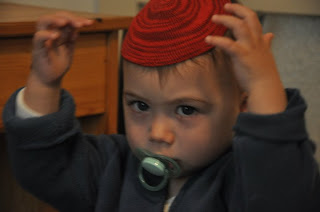
Baby Resilience
Grandchildren are perhaps the greatest of comforts to bereaved parents. Grief for a child who has left this world never ends completely, but its pain is greatly softened, and even sometimes forgotten – this is true for me, at least – when we spend time with our children’s children. As I've written in my memoir:
"It’s as if a deep pit opened up inside me.... I’ll never be able to fill the hole, but what I can do is build my life around it, continually adding meaningful relationships, work, and creative pursuits, so that the pit becomes a proportionally smaller and smaller part of my being. It’s still there, but it’s dwarfed by its surroundings."
My grandchildren certainly dwarf that pit.
Daniel and I have many times had the good fortune to host our oldest daughter Elisheva and her partner Tayir for Shabbat together with their son Imri, who is now twenty-one months old (Elisheva is Imri’s biological mother, and Tayir is in the process of adopting him). Two weeks ago we were even luckier, when the couple took a two-day vacation alone (their first since Imri was born) and left him with us. Besides the great fun we had with him, we also got a bonus – the opportunity to witness his budding resilience.
When they visit, Imri normally runs into our home as soon as we open the door, shouting “Ka!” (his name for me) and “Abba!” (his name for Daniel). When they arrived that Friday, though, he refused to walk in. His mothers hadn’t said anything to him – at his age there would be no point, as he can’t yet grasp a concept like “two days” – but he could tell something was up. Eventually they carried him in. It took about an hour before he was willing to stop clinging to Elisheva or Tayir, and to come to us.
When he seemed ready, they waved to him and said, “Shalom, Imri. We’re going for a trip now, but we’ll be back.”
“Lom, Mma!” he replied, waving, and turned back to put another block on the tower he was building.
Imri’s mood remained excellent throughout the weekend. I took him to synagogue Shabbat morning, as I always do, and he played, looked at his books, and went up and down the aisle flirting with everyone in the women’s section, as he always does. At home, he played with us, ate happily, and talked and talked and talked.
The first time he asked for his mother was when I was putting him to sleep Friday night. I said, “Eema isn’t here, but Savta (Grandma) is here, Sabba (Grandpa) is here, Ayala is here, David is here,” and so on, naming everyone who was with us for that Shabbat, including his two-month-old cousin Arielle. “Eema will be back tomorrow.” He calmed down right away and fell asleep. He asked for “Mma” again only another couple of times, when he was tired or fell down, and each time we were able to calm him quickly.
Don’t get me wrong – he didn’t forget his mothers. On Sunday, we explained that Eema would be back later. A short time afterward, we were playing in the living room when David came out of his room.
“Who’s that coming?” I asked Imri.
Immediately a huge smile lit up his face. “Mma?” he asked hopefully.
“No, it’s David,” I said. “Eema will come later.”
He looked at me seriously for a second, then went back to the book he was leafing through.
For a while after his mothers returned he wouldn’t get off Elisheva’s lap, or stop hugging her. I came to sit down beside them, saying things like, “Your Eema’s back! That’s so great for you!” At first he looked out at me a bit suspiciously from the safety of the maternal lap. But after a few minutes, he suddenly gave me a big grin. “Ka!” he said lovingly. Then he looked at Elisheva and said, “Mma!” Then again at me, “Ka!”
When we took the three of them out to dinner that evening, he sat happily next to me, smiling from time to time and saying “Ka!” in that loving tone. I melted every time.
Clearly, he wasn’t holding a grudge – at least while his mothers were there. But the real proof of his forgiveness came the next day, when they were safely back at home in Tel Aviv. Elisheva phoned me for some advice, and suddenly I heard in the background, “Ka? Ka!”
“He recognizes your voice,” she told me.
“Even when you’re the one talking with me?”
“Yup. He knows telephone voices from across the room.” We finished our conversation and hung up.
About an hour later, the phone rang. It was Elisheva again. “He insists on speaking with you,” she said.
She put him on and we had our usual conversation.
“Hello, Imriki?”
“Yes.”
“Did you call me?”
“Yes.”
“Did you call me to give me a kiss?”
“Yes.”
“So give me a kiss.”
He made a loud kissing sound and gave the phone back to his Eema.
I’m floored by Imri’s ability to stay with us and feel almost no distress, and to go back afterward to his normal life, free of anger. To me, this demonstrates a resilience rooted in the deep basic trust that he's developed through the loving and patient mothering he’s gotten all his life from Elisheva and Tayir.
I believe that resilience is one of the most crucial qualities we can nurture in our children. I'm sure that Imri's will stand him in good stead, throughout what I hope will be a long and eventful life.
Thursday, March 10, 2011
Twice the Marrow: Reactions
I've added to my reviews page a quote from Dr. Debbie Weissman, President of the International Council of Christians and Jews, highly recommending my memoir:
"While focusing on the author's deeply Jewish experience and perspective, And Twice the Marrow of Her Bones is inspiring to people of all faiths, or none. A must-read for both my Jewish and Christian students and colleagues."
"While focusing on the author's deeply Jewish experience and perspective, And Twice the Marrow of Her Bones is inspiring to people of all faiths, or none. A must-read for both my Jewish and Christian students and colleagues."
Monday, March 07, 2011
Poems after Relapse, in English Translation
In January I posted three Hebrew poems that Timora wrote after the relapse of her leukemia was diagnosed, as with the steady return of cancer's incomparable pain she began to lose some of her cherished independence.
As I wrote in my memoir, what stands out for me in Timora's poetry is her astounding ability to transform suffering into art. If you think about it, that is what all artists do, and Timora was a true artist.
Warning: The second and third of these poems are very difficult to read.
March 19, 1999
Don’t tell me,
I know by myself,
If I don’t do it
It doesn’t mean a thing,
Leave me.
Tell me,
Or I won’t succeed,
I won’t do it,
Help me.
Don’t decide for me,
I’m not a little girl,
I’m responsible for myself,
Leave me.
Protect me,
I’m scared like a little girl,
I can’t stand alone,
Help me.
April 11, 1999
As I wrote in my memoir, what stands out for me in Timora's poetry is her astounding ability to transform suffering into art. If you think about it, that is what all artists do, and Timora was a true artist.
Warning: The second and third of these poems are very difficult to read.
March 19, 1999
Don’t tell me,
I know by myself,
If I don’t do it
It doesn’t mean a thing,
Leave me.
Tell me,
Or I won’t succeed,
I won’t do it,
Help me.
Don’t decide for me,
I’m not a little girl,
I’m responsible for myself,
Leave me.
Protect me,
I’m scared like a little girl,
I can’t stand alone,
Help me.
April 11, 1999
It
is
spreading further and further
and
conquering every spot that had been free
Poisonous, black malicious
Snickering of devastation, of evil, of defenselessness, of some
dark power
Extending long and emaciated and terrible and destructive arms
that grow
like some horrible nightmare from which we’ve not awakened and we'll not
awaken
ever
And twist and twist
and distort
and deform
and hold on
Hold fast by the nails Hold and do not let go Hold fast and wound
And if it does not bring death it will bring destruction of some other kind
Because there are no few kinds (to each his own destruction) Here it’s
bringing
is
spreading further and further
and
conquering every spot that had been free
Poisonous, black malicious
Snickering of devastation, of evil, of defenselessness, of some
dark power
Extending long and emaciated and terrible and destructive arms
that grow
like some horrible nightmare from which we’ve not awakened and we'll not
awaken
ever
And twist and twist
and distort
and deform
and hold on
Hold fast by the nails Hold and do not let go Hold fast and wound
And if it does not bring death it will bring destruction of some other kind
Because there are no few kinds (to each his own destruction) Here it’s
bringing
April 20, 1999
A black cloud of razor-sharp claws.
They scratch deeply into my flesh
If I ask who sent them, and why to me,
They continue to pierce in silence.
A black cloud of claws that wound.
They’ve pulled me toward pain’s abyss
I cannot scream out how evil they are –
After all, does a claw have a heart?
A black cloud of claws that rip.
A claw has reached my core
And there it tears off strips of my soul
And, giggling, discards them in slime.
A black cloud of murderous claws.
They’ve pulled me toward the great Pit.
But I’ve stood up to them and continue to stand –
I’ve yet to give in to despair.
I've yet to give in to despair. There it is - Timora's resilience, in her own words.
A black cloud of razor-sharp claws.
They scratch deeply into my flesh
If I ask who sent them, and why to me,
They continue to pierce in silence.
A black cloud of claws that wound.
They’ve pulled me toward pain’s abyss
I cannot scream out how evil they are –
After all, does a claw have a heart?
A black cloud of claws that rip.
A claw has reached my core
And there it tears off strips of my soul
And, giggling, discards them in slime.
A black cloud of murderous claws.
They’ve pulled me toward the great Pit.
But I’ve stood up to them and continue to stand –
I’ve yet to give in to despair.
I've yet to give in to despair. There it is - Timora's resilience, in her own words.
Thursday, March 03, 2011
Last Poems of the Remission, in English Translation
Leukemia is an insidious disease, whose effects - both physical and emotional - last well beyond the disappearance of its malignant calling cards, the cancerous cells that fill the blood and keep it from fulfilling its life-giving duties. Even when the cancer seems to be gone, and its treatment seems to be over, its victims - especially, I think, its child victims - are left utterly changed by the experience, and often find themselves strangers to the "normal" world.
These are my translations of two of Timora's Hebrew poems that I posted in January. She wrote these in the last months of her remission, when she was worn down from trying, repeatedly and unsuccessfully, to re-enter the life she'd left behind when she became ill.
November 30, 1997
And all
Has suddenly become gray,
All has faded,
All has darkened,
Now all that’s left is cold.
Bleary eyes
Are tired of wondering,
Why,
And for what,
How,
Until when,
All is finished for me.
Enough.
January 29, 1998
There’s a precious pearl hidden deep in my soul,
It awaits the arrival of he
Who has courage enough to dive into my soul,
And to gaze in my eyes, truly see.
For perhaps I am like a sea-shell from the deep,
Whose facade glitters not, nor intrigues
And whoever would thread it with filament fine
Needs a blade that’s especially keen.
Not a blade, but love that is tender and true
Will pry open this tightly-closed shell,
And although it seems hard, if only he’d try –
Only softness he’d find, smooth and still.
There’s a precious pearl hidden deep in my soul,
If you seek it, it’s right within reach.
But your eyes are shut tight and blind to the light,
They will never discern the true me.
There's little I can add to Timora's own eloquent words.
These are my translations of two of Timora's Hebrew poems that I posted in January. She wrote these in the last months of her remission, when she was worn down from trying, repeatedly and unsuccessfully, to re-enter the life she'd left behind when she became ill.
November 30, 1997
And all
Has suddenly become gray,
All has faded,
All has darkened,
Now all that’s left is cold.
Bleary eyes
Are tired of wondering,
Why,
And for what,
How,
Until when,
All is finished for me.
Enough.
January 29, 1998
There’s a precious pearl hidden deep in my soul,
It awaits the arrival of he
Who has courage enough to dive into my soul,
And to gaze in my eyes, truly see.
For perhaps I am like a sea-shell from the deep,
Whose facade glitters not, nor intrigues
And whoever would thread it with filament fine
Needs a blade that’s especially keen.
Not a blade, but love that is tender and true
Will pry open this tightly-closed shell,
And although it seems hard, if only he’d try –
Only softness he’d find, smooth and still.
There’s a precious pearl hidden deep in my soul,
If you seek it, it’s right within reach.
But your eyes are shut tight and blind to the light,
They will never discern the true me.
There's little I can add to Timora's own eloquent words.
Subscribe to:
Posts (Atom)